


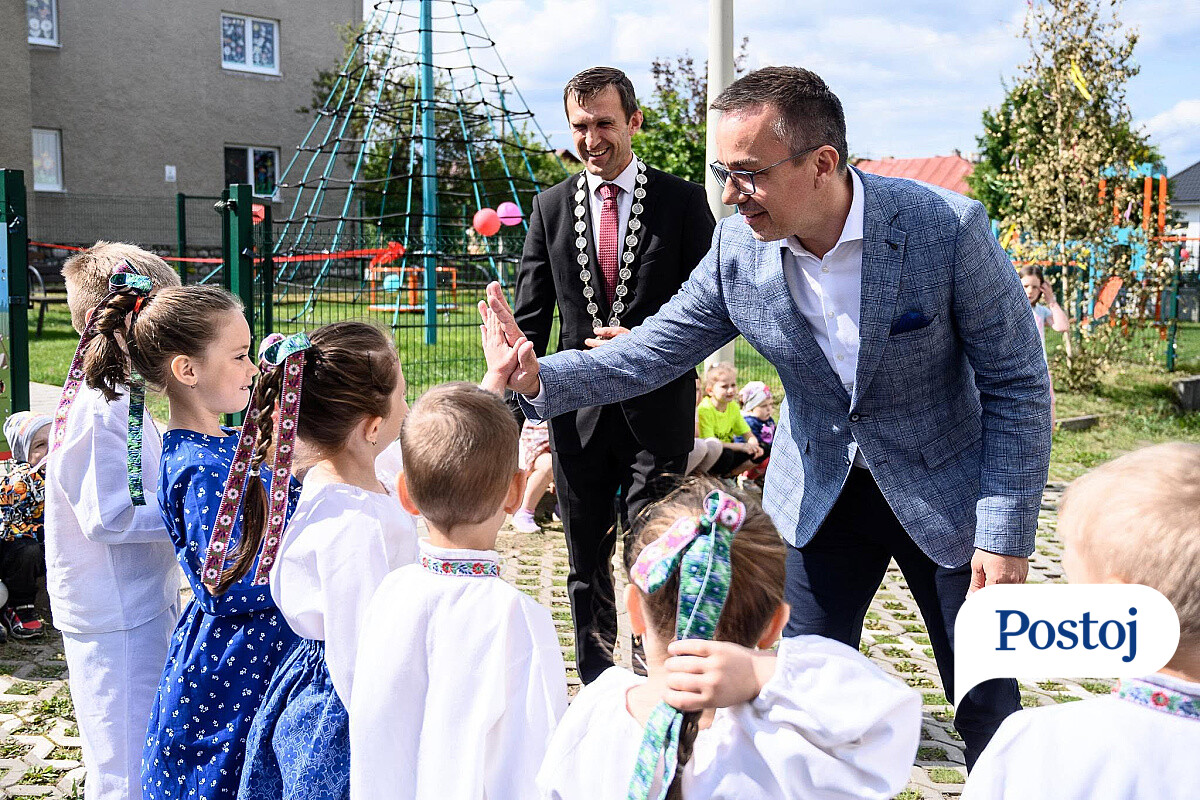
When Milan Krajniak took the chair of the Minister of Labor in 2020, he decided to overhaul the subsidy system that the department provided annually.
He renamed the grant to support gender equality and expanded the range of organizations that can participate in it. He introduced two new subsidies: one to support volunteering and the other to support the fulfillment of family functions.
The goal was to support preventive programs, education, publishing activities and thus prevent negative phenomena in the family or strengthen intergenerational relations. The subsidy could also be used for the construction of inclusive playgrounds.
Organizations could receive a maximum of ten thousand euros from the subsidy, if it was about the construction of a playground, it could be up to 50 thousand.
Already in 2021, almost 2.5 million euros were redistributed as part of the call to support family functions.
Although it is true that in the first year most of the money from the appeal went to the construction of playgrounds, almost 50 non-governmental organizations also received support.
A few years passed and the subsidy, which was meant to support families, became a tool almost exclusively for the construction of playgrounds. Many organizations lost one of the few public sources of funding.
One hundred percent project was not enough
Among them was also the non-profit organization Tlaký hrniec, which is devoted to the prevention of addiction to pornography. It organizes workshops for primary and secondary school students, and as the director of the organization Lívia Halmkan says, interest from school institutions is increasing.
However, this did not affect the success in drawing subsidies, quite the opposite.
She managed to get the subsidy between 2021 and 2024, last year and this year she didn’t get the support either.
The ministry told Lívii Halmkan that their project received a hundred percent evaluation from the commission, but it was not enough to get a subsidy. The minister decides who will receive the money in the end, based on the commission’s assessment.
window.googletag = window.googletag || { cmd: [] };
window.protag = window.protag || { cmd: [] };
window.protag.cmd.push(function () {
window.protag.display(“protag-article_2”);
});
The official reason is the exhaustion of the allocation of budget funds, taking into account the limit of public expenditures.
In other words, there is no money left for this project.
Instead of playground organizations
This is not an isolated case: in recent years, the redistribution of subsidies to support family functions has changed significantly.
While 48 non-governmental organizations were supported in the first year, this year there were only seven of them. In 2025, even only two, while even in the case of one of them it was actually about the construction of a playground.
The problem is not a lack of funds. The total amount that went to this subsidy grew significantly. In 2021, 2.5 million euros were redistributed, this year it was almost 8.2 million.
Despite the increase in resources, however, support for non-governmental organizations decreased.
While in 2021 they managed to get more than 340,000 euros from the package, this year it was less than 69,000 euros.
The rest of the money, i.e. more than eight million, went to the construction of inclusive playgrounds in municipalities throughout Slovakia.
They lost the only state support
In the years when the Pressure Cooker was successful in the challenges, it won a little less than ten thousand. It is not a big sum, but in the first years of operation, according to Lívia Halmkan, they were able to cover half of the office’s operating costs in this way. Today it is about one fifth.
However, it was the only public subsidy they managed to get.
“We also asked for money from other ministries, but we never succeeded. Maybe that’s the topic we’re working on,” says Halmkan.
The interest of schools in their programs is growing exponentially. “We want to cover the demand, but we are overwhelmed with phone calls and emails. We try to send tutors wherever we can,” he says.
“The fact that we did not receive a subsidy was a signal for me. We are doing a task that, in my opinion, the state could easily do. There is a lot of interest in it, but the state does not reflect this at all,” he states.
They finance the operation of the Pressure Cooker through the fees that schools pay for the workshops, but they cover only part of the costs. The rest is covered by private donations and what they collect through remittance of two percent of the tax.
Alexis Counseling has a similar experience. Even they have not received a subsidy for the last two years. After requesting the results of the committee’s evaluation, they found that their project had received more than 99 percent, but not enough to be successful.
window.googletag = window.googletag || { cmd: [] };
window.protag = window.protag || { cmd: [] };
window.protag.cmd.push(function () {
window.protag.display(“protag-article”);
});
As Zuzana Stohlová Kiňová, director of the consultancy, told Postoj, they continued to take an interest in the matter and requested a list of successful applicants from the ministry, including a point evaluation. However, the department did not provide them with the explanation that according to the law on access to information, they are not obliged to do so.
“This subsidy was one of the key resources for us. It is a significant shortfall for us,” says Stohlová Kiňová. At the same time, this is the only support from state money.
The ministry avoids the explanation
The Ministry of Labor did not explain the significant drop in support of non-governmental organizations.
The communications department replied that civic associations, non-profit organizations, church organizations, municipalities or other entities can continue to apply for subsidies to support family functions, and the conditions for non-governmental organizations have not changed.
“The amount of support for individual types of applicants is the result of the evaluation of submitted projects and the fulfillment of legal conditions. In 2026, for example, part of the applications of non-governmental organizations no longer passed formal control, and some of the projects that were evaluated were supported,” they said.
So we asked if the priorities in this area had changed, but according to the ministry, that didn’t happen either.
“Subsidies can also be used for preventive programs for families, support for parenting skills, events for families with children with disabilities, self-help groups or other activities to support the fulfillment of family functions,” confirmed the department.
They did not explain why the support for these programs and activities dropped so significantly.
The state relies on NGOs, but does not support them
According to the chairwoman of the Life Forum, Marcela Dobešová, the financing of non-governmental organizations that are involved in the social field is generally poorly set up. The fact that they have to apply for subsidies every year means that they are never sure if they will receive the funding. This makes it much more difficult to ensure continuous operation.
Many times these are organizations that provide social services and the state relies on them to a great extent.
“It’s a paradox. If you want to perform a social service, you must be registered in the register of social service providers and meet various conditions, but you are not guaranteed funding at all,” points out Dobešová.
In addition, the Ministry does not have the obligation to further justify the non-granting of the subsidy. “Although on paper it is a transparent instrument of support, in practice it is one of the weakest points of the entire social policy,” he adds.
This is also shown by the case of the non-profit Yes for Life, which we reported on last fall. It helps pregnant women, but also provides support and accommodation for abused women who have nowhere to go.
These are services that are in short supply in Slovakia, but they were unsuccessful in requesting support from the Ministry of Labour. And this despite the fact that the ministry did not use up the total amount it had for this purpose.
The subsidy for the support of family functions, which was introduced by Krajniak, was one of the few sources thanks to which non-profit organizations dedicated to pro-family activities could raise money.
As the numbers show, this resource is also gradually drying up since the arrival of Minister Erik Tomáš. The paradox is that it is Tomáš who calls family support one of his priorities, and the Hlas party, to which he belongs, also plays this card.
And on billboards, Hlas is now promising a tax waiver for mothers or a higher allowance for the birth of a child. However, families can be helped in other ways, for example by supporting organizations that actually help families.
Source: Postoj

