


The private health insurance company Dôvera, which belongs to the Penta group, is buying the health insurance company Union, which belongs to the Dutch insurance group Achmea.
This will create a duopoly in Slovakia: in addition to the state-owned General Health Insurance Company, there will be only one private health insurance company, Dôvera, owned by Penta. They will divide the market roughly in half.
The Dutch Achmea is not leaving Slovakia entirely, it is only withdrawing from the public health insurance segment. He will continue to work in the commercial insurance industry (life and non-life insurance).
According to people who deal with this sphere, the merger of two private health insurance companies is the biggest news in the Slovak health sector in decades.
Trade unionists and opposition politicians are critical. They fear less competition, less choice for health care providers and patients, as well as the strengthening of the influence of the Penta financial group.
Accusations have already begun as to who is responsible for the end of the Union health insurance company. Šimon Jeseňák, who is close to the concept of the former Minister of Health Rudolf Zajac and works as the editor of the portal ozdravme.sk, he accused on Facebook ex-minister Marek Krajčí, that Achmea is also leaving as a result of the department’s campaign against private health insurance companies under the government of Igor Matovič. The transaction tax introduced by the current government was allegedly just the last straw…
Undoubtedly, more such exchanges will take place in the coming days. Well, it’s a shame that we’re only now discussing what kind of healthcare we actually want in Slovakia.
Even in the opposition, there are voices that allow private companies to make a profit from compulsory public health insurance was wrong and immoral. And they would probably agree if there was only one state health insurance company.
window.googletag = window.googletag || { cmd: [] };
window.protag = window.protag || { cmd: [] };
window.protag.cmd.push(function () {
window.protag.display(“protag-article_2”);
});
However, the question is how to ensure that such a state monopoly does not fall into increasingly expensive and lower quality services (which state monopolies tend to do).
However, there is also another concept: on the one hand, to divide the state General Health Insurance Company and sell these parts to other health insurance companies that could enter the Slovak market, on the other hand, to clearly define which health care is covered by levies and what already belongs to the super-standard in which health insurance companies could compete.
Here again the question is how to ensure that the state regulator (arbiter) of such a competition does not become a hostage of private financial interests.
At this point, one could conclude that in Slovakia we have the worst of both worlds described above: neither a fully competitive market, nor fully state-run health insurance – but a state-private oligopoly that will soon turn into a duopoly…
Perhaps it would help if we in Slovakia talked more about what kind of health care we actually want, instead of such “vitally important” topics as the revolver that President Pellegrini received from Turkish President Erdoğan, or the controversy over the Pohoda music festival – both fundamental issues that have been discussed on the Slovak internet for the past week.
As already mentioned, Achmea is not leaving Slovakia. It is withdrawn only from the public health insurance segment. Despite this, one cannot avoid the impression that several reports about possible exits in the business have recently emerged, which could shock or directly concern the public.
According to the British newspaper Financial Times, the British chain Tesco could leave Slovakia. No, the reason is not necessarily “because of Fico”.
Tesco will probably also withdraw from Hungary and the Czech Republic. In the future, he is to focus on the British Isles, where the center of gravity of his business is located.
The reasons include strong competitive pressure from discounters (Lidl, Aldi). But also a relatively small share of Central European operations in the profits of the entire brand.
window.googletag = window.googletag || { cmd: [] };
window.protag = window.protag || { cmd: [] };
window.protag.cmd.push(function () {
window.protag.display(“protag-article”);
});
It could be blamed on the government that it increased taxes on Slovaks and they then spend less. But if Tesco leaves, so will other countries in the region. A different policy of the government in Slovakia would probably not make a difference.
If Tesco simply closes its stores, the consequence for Slovak customers will be less competition and therefore higher prices. However, this scenario may not occur. If Tesco leaves and is replaced by another chain, the customer may not even feel the change.
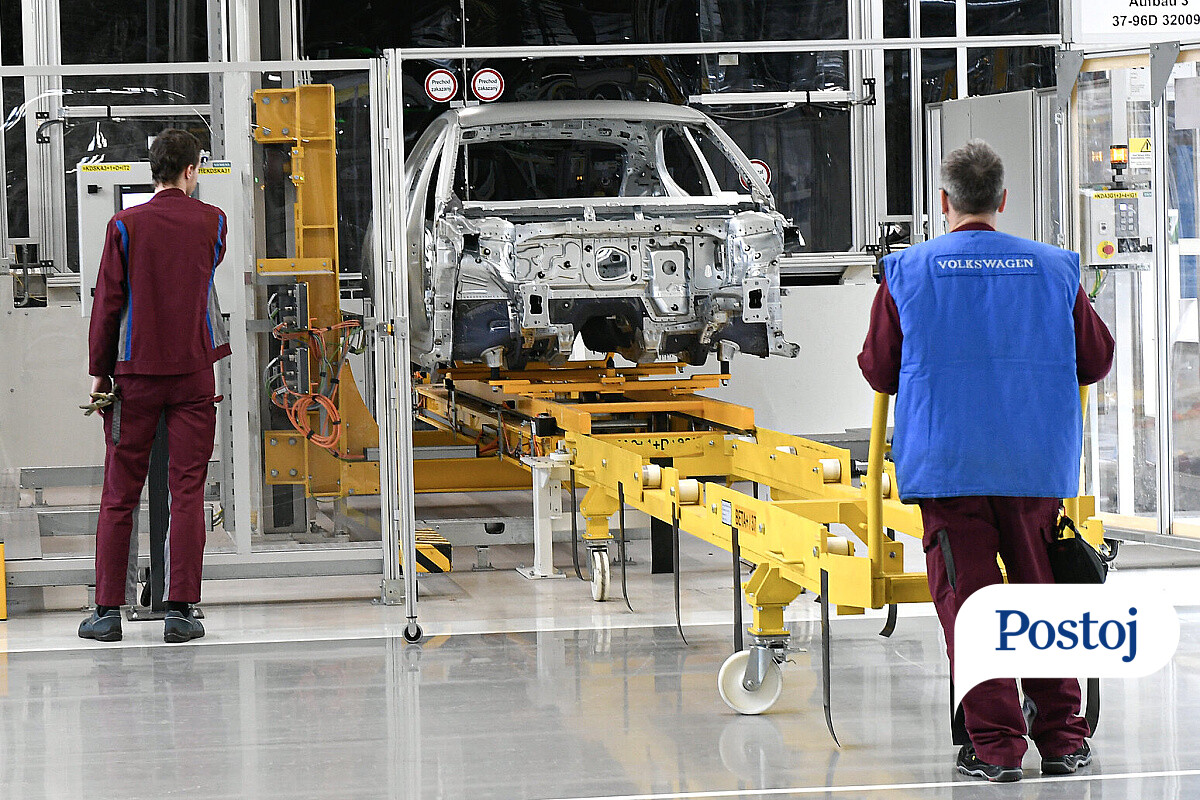
More serious is the threat that the Bratislava plant of the Volkswagen concern will lose the production of the Porsche Cayenne model, which could be moved to the factory in Leipzig, Germany.
The simple justification “because of Fico” does not fit here either. Volkswagen as a concern has problems on a global scale, which it wants to solve by slimming down the range of models and canceling about 100,000 jobs out of a total of about 660,000 employees worldwide.
The reasons include a drop in sales on the Chinese market, stronger competition from local automakers, problems with software and the transition to electromobility, high production costs in Europe (expensive energy and labor) or American tariffs, which make it difficult to sell even on the American market.
Although a more suitable economic policy and greater interest of the government in Slovakia could improve the position of the Slovak Volkswagen within the concern, the company as a whole would be most helped by reforms at the level of the federal republic and the European Union, in addition to internal management decisions.
One thing speaks against the transfer of Cayenne to Germany: the trade unions there would have to agree to a reduction in wages.
And if the Bratislava-based Volkswagen had to lay off workers, there is still a small patch: at the beginning of 2027, the Volvo car company is to start production of electric cars in the Valaliky industrial park near Košice…
Internet debaters under articles about the fact that some company is going to leave Slovakia or in some way limit its activity on the Slovak market, tend to reduce the reasons to the incompetent policy of the current socialist government. However, internal reasons, the changing position of the brand on the market or deeper global reasons often have a comparable or greater weight in companies’ decisions.
Companies came to and left Slovakia in the past: does anyone still remember the French hypermarket chain Carrefour, which came to us in 2000, grew for a while, but left Slovakia in 2018?
It is important for the country to continuously work on the quality of the business environment, develop transport and energy infrastructure and invest in human capital (meaning people’s health and education). And so that Slovakia is internationally competitive in attracting foreign capital and at the same time a favorable environment for the creation and expansion of domestic business.
Source: Postoj

