


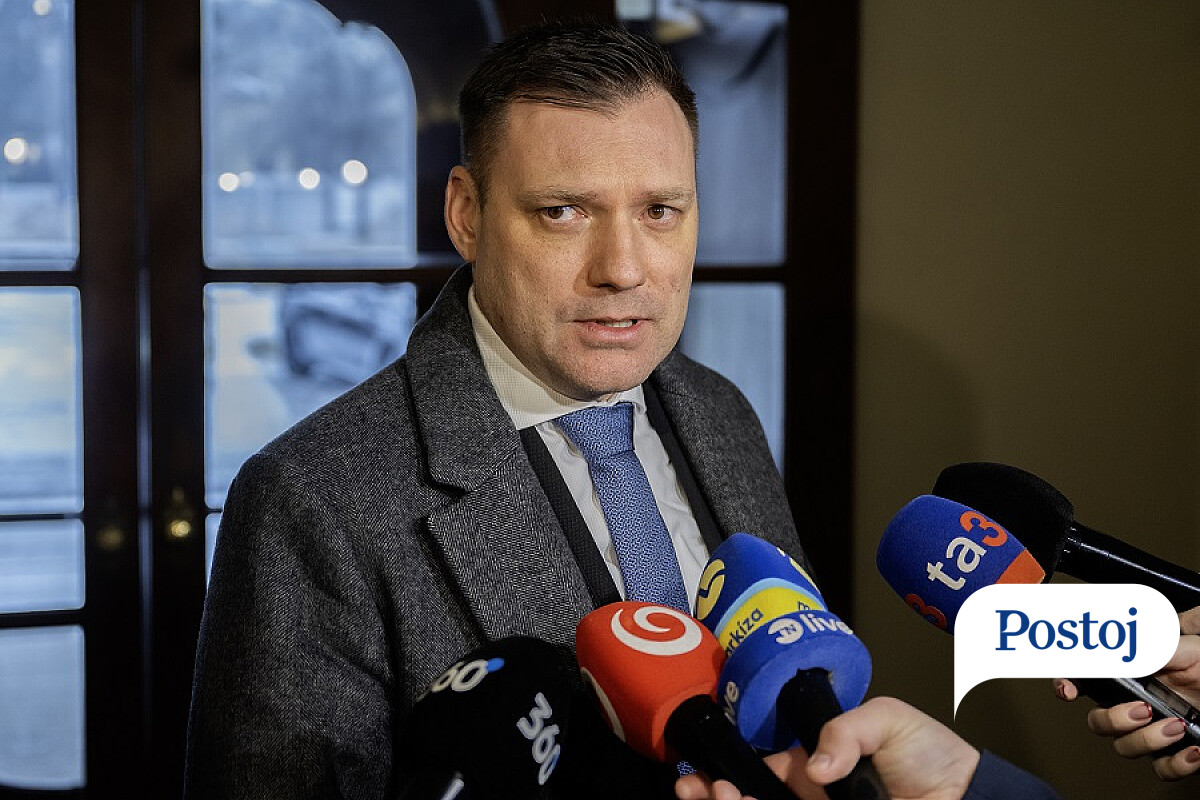
Although the Minister of the Environment Tomáš Taraba is currently mostly deciding whether and how long he will remain as minister, it can be said that he has been relatively successful in promoting the department’s agenda recently.
We recently wrote about his proposal in the framework of the geological law, which introduces the possibility of fining people who will defend their land against the arbitrary entry of persons carrying out geological exploration.
This change was part of a wider package, the main part of which consists of changes in the area of environmental loads. Although Tarabo managed to push through changes in both laws at the government meeting twice, he still has to go through the approval process in parliament.
With the Act on Environmental Loads, the Ministry of the Environment already in press release praised that it finally brings a functional mechanism for the removal of environmental burdens on land whose owner is not a direct source of pollution, which until now complicated the determination of the so-called obliged person.
Help Babiš?
It was not Tarab’s first attempt to push for changes in the area of environmental burdens. However, the other one, from the end of last year, was, according to critics, too closely tied to the interests of Czech Prime Minister Andrej Babiš, whose company Agrofert owns land in the Istrochem area (former Bratislava Chemické závody Juraj Dimitrov, CHZJD).
There was a suspicion that the way Taraba wanted to take over the state’s obligations for the removal of environmental burdens was aimed at cleaning up the Istrochem area at the expense of Slovak taxpayers, so to speak, which would pave the way for Agrofert (Babiš) to turn these plots into valuable parcels for housing and other construction.
The “cheaply” bought brownfield would thus become expensive building plots at the expense of Slovak citizens.
In this regard, Agrofert argued that the contract by which it acquired the land from Istrochem stated that it should invest money in ecological and environmental measures. Agrofert claimed that it made these investments, although they did not necessarily have to do with the remediation of the environmental burden after the heavy chemical production that had been going on at CHZJD for years.
The attempt to have the state take over the costs of removing the pollution in Istrochem was finally stopped by the Bratislava regional prosecutor’s office, which contested the decisions of the District Office in Bratislava that the state is the liable party in the case of environmental pollution in the Istrochem area.
According to Minister Tomáš Taraba’s interpretation of the current proposal, the state will obtain a lien on the land on which it will remove the environmental burden, if the owner of the land does not do so. Although it means initial costs for the state to remove the pollution, the lien is supposed to guarantee that the state will recover this money or acquire the land.
Although it means initial costs for the state to remove the pollution, the lien is supposed to guarantee that the state will recover this money or acquire the land.
However, it is not so clear-cut.
The basis for the removal of pollution and the minimization of state costs is that the debtor, i.e. the owner of the land with the environmental burden removed, will repay his debt.
However, in some cases, he does not have to do that, because one of the added paragraphs in Tarabovo proposal it says that “the claim (…) is time-barred after the expiration of ten years from the date of expiry of the deadline for payment of the claim (…). If the relevant ministry does not send a call according to paragraph 5 within 60 days from the day when it received a valid decision on the termination of the implementation of the work plan according to Section 9, paragraph 7, the claim will become time-barred after the expiry of ten years from the day following the expiry of the deadline for sending the call”.
This means that if some official “forgets”, the owner of the land on which the state carried out the removal of the environmental load will have to wait ten years, and the costs of removing the pollution will remain on the account of taxpayers.
A geological survey with clearly defined boundaries of the polluted area will have to be a condition for the removal of environmental pollution.
This is where another problem arises, with which Minister of Sport Rudolf Huliak justified his disagreement with the amendment. Geological exploration on private land can only be carried out with the consent of the owner of the land – the protection of private property still applies and its violation, i.e. expropriation or other restriction (e.g. lien or right of pre-emption), is possible only within constitutional limits and in the public interest.
Although the removal of serious pollution, i.e. environmental burden, is in the public interest, the extent of this pollution can, according to the proposal, only be determined on the basis of a detailed geological survey. In essence, the law thus turns in a circle.
Clean environment or lower costs?
On the one hand, it is necessary to start with the removal of the most serious environmental burdens. And it is of little importance whether they are located in the agglomeration of the capital or in the forgotten valleys after bankrupt industrial enterprises from the time of the communist regime. A healthy environment is a public concern always and everywhere.
On the other hand, even the other approved proposal raises questions that can easily block the entire process through legal hurdles and clashes with constitutional rights.
If we have to choose between the alternative that the state, i.e. the taxpayers, will save direct expenses, but the polluted environment with negative effects on the future life and health of people and the country will remain, and the state when public resources will be spent on eliminating pollution even with the risk that their so-called the obliged person never pays, the second mentioned is always a better solution.
It is also true that if it makes sense to penalize someone for not allowing the arbitrary movement of geological explorers on their land, it should explicitly refer to territories “suspected” of pollution, which investors have bought in order to profit from them for development. Not people who defend their own houses, gardens and fields from senseless megalomaniac investments. As, for example, in the case of Čechanok, where Tomáš Taraba wants to enforce the construction of a reservoir for a pumping station by force.
Source: Postoj

