


Flute, harp and percussion instruments in the main roles in Žilina
At the next two concerts, the Žilina State Chamber Orchestra will perform works for non-traditional solo instruments: flute, harp and percussion.
Vo Thursday On May 14 at 7 p.m., under the leadership of chief conductor František Macek, a pair of Czech soloists will perform in the Mozartian repertoire: harpist Kateřina Englichová and flutist Petr Pomkla.
After the overture to the opera Something fan tutte it sounds melodious and elegant Concerto for flute, harp and orchestra, which Mozart composed during his stay in Paris. The composition was commissioned by amateur flutist Adrien-Louis de Bonnières, Duke of Guînes, for himself and his daughter, who played the harp and received composition lessons from Mozart. In the end, however, the maestro was not paid for the concert, the duke even offered him through his housekeeper only half the fee for lessons for his daughter, which Mozart indignantly refused.
Then we will listen to slow and melodious ones Andante for flute and orchestra with the same cast as the previous concert, for two oboes, two horns and strings.
The highlight of the evening will be one of Mozart’s most important orchestral works, virtuoso, energetic and joyful Symphony no. 35composed by Mozart in honor of Siegmund Haffner’s elevation to nobility, hence its often-used name Haffnerova.
At the concert in Thursday On May 21 at 7 p.m., flautist Klára Kubriczká Přecechtělová and percussionist Marián Michalec will perform with the Žilina State Chamber Orchestra under the baton of conductor Konstantin Ilievsky.
After the opening overture The Hebrides Felix Mendelssohn Bartholdy, which masterfully portrays the atmosphere of the Scottish countryside, the orchestra will pay tribute to its Žilina native Pavlo Kršek.
Concerto for flute, drums and orchestra it is interesting for its coloring, which Krška achieved by alternating three instruments. The flautist plays a different instrument in each of the three parts: first the transverse flute, then the alto flute and finally the piccolo. They are complemented by the distinctive rhythm of percussion instruments.
We will listen in the second part of the concert Serenade no. 1 by Johannes Brahms, one of the first major orchestral works of this German romantic composer. The work, which has six parts and a structure and scope close to a symphony, is full of joy, pastoral atmosphere, youthful freshness and lyrical melodies.
Verdi’s Requiem in the Slovak Philharmonic
Messa da Requiem is a wonderful work of Giuseppe Verdi. It is an opus that is extremely dramatic, contrasting and full of strong emotions, like Verdi’s opera after all.
However, it differs from them, despite the frequent label “opera in disguise”. Indeed, Verdi requires the interpreting tenor to sing his parts as a mass, not as operatic arias, his vocal expression should be more like a singing priest than an opera singer.
The inspiration for the work was Verdi’s ambition to pay tribute to the late composer Gioachino Rossini. Already four days after his death, he approached the publisher Giuseppe Ricordi, whose name still bears one of the most important sheet music publishers in the world, with the idea of presenting a funeral mass Requiem on the first anniversary of the death of this giant of Italian and French opera.
Individual parts were shared by thirteen Italian composers, maestro Verdi composed the last part Libera me, Domine, de morte aeterna (Deliver me, Lord, from eternal death), which is a prayer for salvation on the day of the last judgment.
Messa per Rossini however, it was not listed in the end. The Teatro Comunale di Bologna, which was supposed to provide the staging, feared that this would jeopardize the commercial success of its opera season. There were attempts to postpone the date or move the premiere to Milan. The work gradually fell into oblivion.
It was rediscovered by the American musicologist David Rosen in 1986, and the world premiere took place in 1988 at the European Music Festival in Stuttgart. In Pesaro, Italy, Gioachino Rossini’s birthplace, where the premiere was scheduled for November 13, 1869, they said Messa per Rossini until last year, 156 years after the planned premiere.
However, Giuseppe Verdi decided to compose his own Requiem, which he dedicated to the important Italian philosopher and writer Alessandro Manzoni.
Messa da Requiem was first performed as part of the mass on May 22, 1874 in the Church of St. Mark’s in Milan, precisely on the occasion of the first anniversary of Manzoni’s death. Giuseppe Verdi incorporated an already composed part into it He frees mefrom Messa per Rossini and conducted it himself. The work under his baton had its premiere three days later in Milan’s La Scala.
The Slovak Philharmonic will perform Messa da Requiem in Thursday May 21 and Friday May 22 at 7 p.m. led by the Austrian conductor Sascha Götzel. The Slovak Philharmonic Choir will be prepared by the head choirmaster of the Vienna State Opera, Thomas Lang, the quartet of soloists will be Sara Duchovnay (soprano), Ester Pavlů (mezzo-soprano), John Irvin (tenor) and Nicolas Legoux (bass).
Opening of the jubilant Košice Music Spring Festival
Opening concert of the jubilee LXX. year of international festival The Košice Music Spring will traditionally be performed by the local Košice State Philharmonic. In the staging of Stanislav Kochanovský, the current chief conductor of the North German Radio Philharmonic (GDR Radiophilharmonie) based in Hanover, they will perform in Thursday On May 21 at 7 p.m. at the Dome of the Arts in Košice, an extremely attractive program for the audience.
It will be heard in the first part of the evening Concerto for piano and orchestra no. 1 Fryderyk Chopin, I guess the most popular work of high romanticism for piano and orchestra. The beautifully lyrical passages of Chopin’s poetry in the first two movements alternate with the equilibristic, technically demanding third part.
The interpretation of this concerto, in which the piano is significantly more dominant than the orchestra, is a challenge for any pianist.
Since Chopin’s compositional style is strongly influenced by opera and especially bel canto, he requires the soloist to be able to sing directly on the piano. The performance also requires very delicate work with the tempo and a specific approach to the dynamics and color of the tone, so that the pianist creates a wide palette of sound colors, subtle shades of mood or the already mentioned lyrical poetics.
Arsenii Mun, a young Russian pianist of Korean origin, will play the role of soloist. In 2023, he won the international piano competition in Bolzano, Italy, where he won not only the first prize, but also the prestigious Arturo Benedetti Michelangeli Prize, which is awarded by the jury only in case of unanimous agreement, and the last time it was awarded almost thirty years ago.
We will listen in the second part of the concert Symphony no. 5 by Sergei Prokofiev, in which there are echoes of the victorious armies of the Allies over Nazi Germany. He wrote it in less than a month in 1944 in Ivanovo (250 km northeast of Moscow), a refuge for Soviet artists, where Aram Khachaturian and Dmitri Shostakovich also worked.
The premiere took place under the baton of the composer himself in January 1945 in Moscow, just a few days after the news of the great victory of the Soviets on the Vistula River, the last major battle on Russian soil. In March it was performed in Leningrad, in May in Paris and in November in Boston.
The Marriage of Figaro in Bratislava and La Traviata in Košice
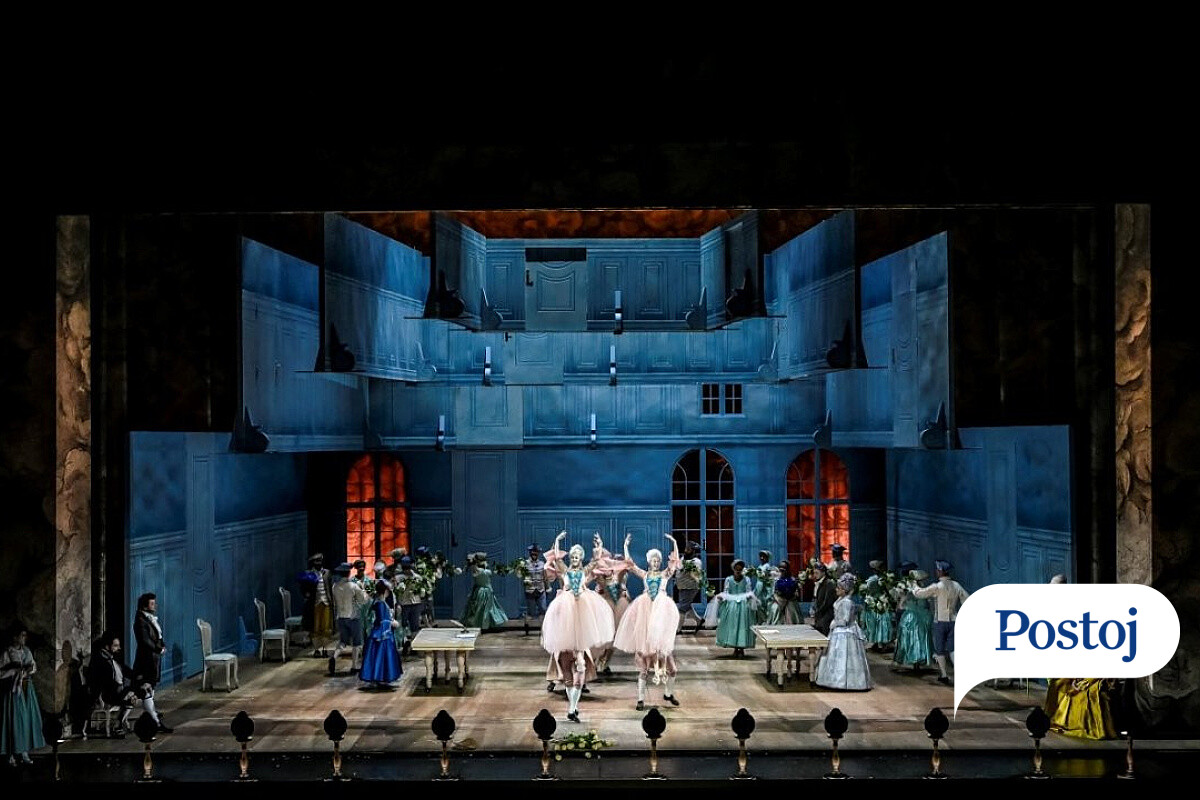
The Slovak National Theater will present the third opera on Friday, May 22 and Sunday, April 24. premiere season The Marriage of Figaro Wolfgang Amadeus Mozart. This is a long-postponed collaboration project since the covid-19 pandemic, namely with the National Theater Brno and the French Théâtre de Caen.
The production by the production team of director Jiří Heřman, scenographer Pavel Svoboda, costume designer Alexandra Grusková, lighting designer Daniel Tesař, choreographer Marek Svobodník and dramaturg Patricia Částková premiered at the Janáček Opera House in March 2025.
In Brno, we enjoyed it in the opening performances performed by the Collegia 1704 orchestra under the direction of conductor Václav Luks, then the home orchestra under the baton of David Švec took over the performance.
In the SND Opera, we will see a production performed by the domestic opera orchestra, staged by the Brazilian conductor Vinicius Kattah, who as the chief conductor of the Košice National Theater signed up for exceptionally successful musical stagings of Mozart’s operas Don Giovanni a The Magic Flute.
The main characters will be Pavol Kubáň and Svatopluk Sem (Count Almaviva), Mariana Sajko and Simona Šaturová (Countess Almaviva), Lenka Máčiková and Andrea Vizvári (Zuzana), Tadeáš Hoza, Ivan Lyvch and Michal Onufer (Figaro) and Jarmila Balážová and Alena Grach (Cherubín). By the end of the season, the Bratislava Opera will present the work six more times.
The Košice National Theater will perform in premiers on Saturday, May 23 and on Sunday, May 24 at 7 p.m., his third opera premiere, namely La Traviata Giuseppe Verdi. With an extremely limited budget, the local team will sign for the production. The musical staging will be conducted by the chief conductor Peter Valentovič, directed by Anton Korenči and set by Juraj Fábry.
Michaela Várady, Soňa Godarská and Eva Katráková-Bodorová, Alfreda Maksym Kutsenko, Juraj Hollý and Peter Berger and Germont Marek Gurbaľ and Marián Lukáč will alternate in the main characters of Violetta. You can also visit the opera in the pre-premiere on Friday, May 22 at 7 p.m.
Source: Postoj

