


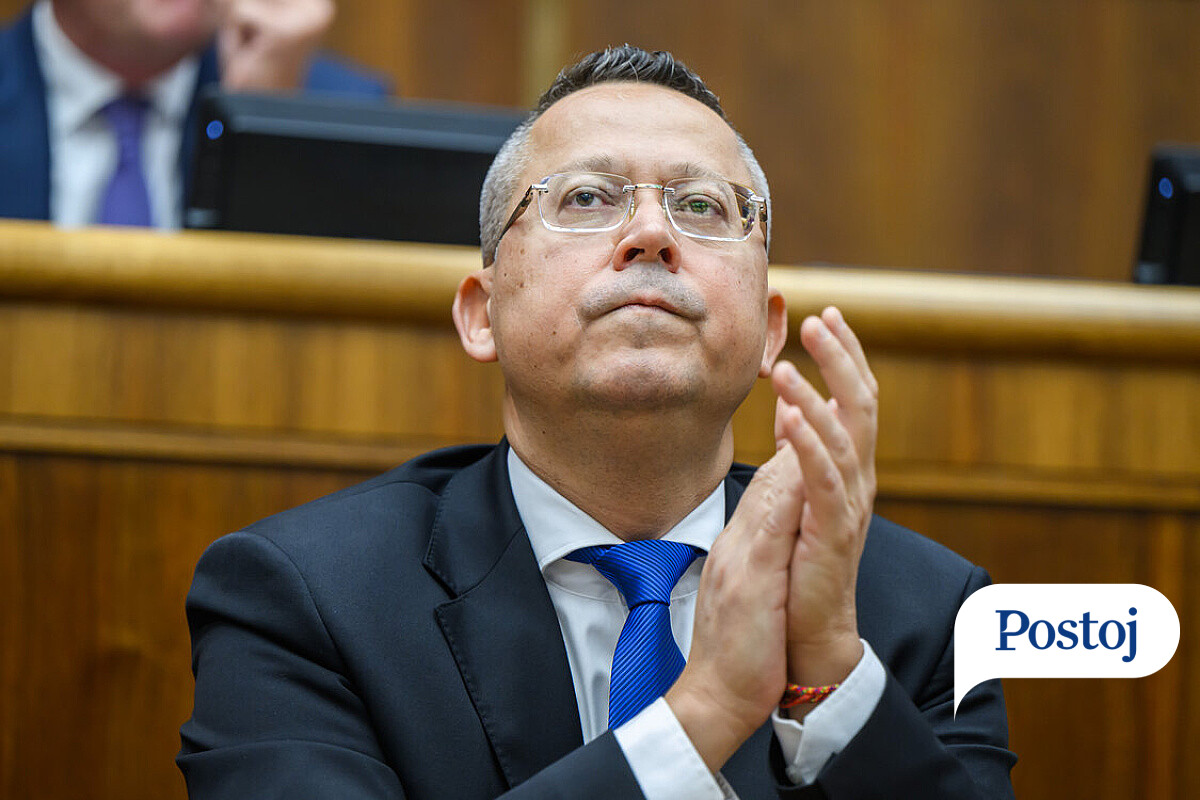
“The government of Fico and Kamenický is destroying the Slovak economy,” SaS chairman Branislav Gröhling reacted almost reflexively to Friday’s news that the S&P agency had lowered the rating of our country.
The KDH also joined in: “Consolidation was supposed to bring recovery of public finances, but it only brought higher taxes,” said Rastislav Krátky, a deputy of the Christian Democrats and a member of the NR SR Committee for Economic Affairs. “We lost trust mainly because of the bad budget policy of the Minister of Finance.”
Štefan Kišš from the strongest opposition party Progresívne Slovakia directly called on Ladislav Kamenický to resign on Facebook: “Laco, sleep well, but then submit your resignation. This is such a scumbag that you really have nothing to do as a minister.”
According to the PS economist and politician, the downgrade will mean “higher interest on our record debt and therefore less money to help people.”
On Monday, Ladislav Kamenický rejected the criticism of the opposition, he does not intend to resign and, according to him, the financial markets have already calculated the reduction of Slovakia’s rating. Nothing extraordinary is said to be happening, because several countries have rating problems due to the bad international economic situation…
In this shootout of public statements, the citizen takes a position apparently in accordance with his political preferences. After all, it is a (seemingly) complicated topic. How can an ordinary person find their way around it?
What are ratings about?
Just to clarify: S&P (originally Standard&Poor’s) is one of the world’s three largest rating agencies (along with Moody’s and Fitch). Their ratings try to express how likely it is that the borrower will or will not repay his debts. The debtor can be banks or some other private companies, but also states, because they also borrow money on the market to cover the difference between their income (taxes, duties and levies) and expenses.
A rating is something like a grade in school. The best grade that a borrower (in our case, the state) can receive from S&P is AAA. It means high credibility – it is almost certain that the borrower will repay his obligations without any problems.
At the opposite end of the scale, D is for “default,” meaning the borrower defaults and S&P believes it generally defaults on most or none of its obligations.
There are several partitions between the “triple A” and the “kid”. For example, among the V4 states, the Czech Republic has the best rating: AA-.
Slovakia is a bit worse. S&P has now lowered our rating from A+ to A.
This still indicates a high ability to meet financial obligations, but the borrower is more sensitive to adverse economic conditions. A-rated entities are generally stable and financially sound, but may face difficulties during economic downturns or periods of financial instability. This rating indicates that while it is likely that the bond issuer will meet its obligations, there is a lower level of risk involved.
Poland is one step below us with an A- rating. Hungary has the worst rating among the V4 states: BBB-, which is only one level above the speculative band.
In other words, the most important border is between BBB- (that is present-day Hungary) and BB+, which is already a speculative zone. The bonds of such states are “junk”. Investing in them is a high-risk speculation.
What S&P says about Slovakia
In principle, all A-ratings mean that the borrower is trustworthy with a high probability of repaying the obligation. Lending to him is quite a safe investment.
Therefore, even the reduction of Slovakia’s rating from A+ to A is not a disaster. As already mentioned, Poland with A- is one step lower.
But if an ordinary person wants to know how the S&P agency really sees us and whether Minister Kamenicky or the opposition politicians are more right, he can make up his own mind. And read directly the report about our country, in which S&P justifies its decision.
You can find news about Slovakia HERE. It is in English. We select from it:
“Weaker economic growth, high spending on social transfers and defense and upcoming parliamentary elections will make fiscal consolidation more challenging than we previously expected. This is the main reason for our rating move on Slovakia.”
Let’s try to break that paragraph down.
The causes of weaker economic growth, which according to S&P will slow to 0.5 percent of GDP this year, are both weak domestic demand caused by the government’s fiscal consolidation and weak foreign demand due to “geopolitical uncertainty” (read: Trump and war conflicts).
The inflow of funds from the EU will work against this trend, but it will gradually weaken. And the start of production at the Volvo car factory next year. As a result, GDP growth could recover and increase to 1.7 percent from 2027, and could approach two percent in 2028.
Under “high expenditures on social transfers” one must imagine not only 13. pensions, but also unaddressed energy aid and the overall low addressability of our social system. Defense expenditures apparently represent payments for F-16 fighter jets, the last of which were delivered only recently and were ordered by the Smer-led government in 2017 (the Ministry of Defense was managed by the SNS). But the current Ministry of Defense also buys in bulk.
The “approaching parliamentary elections” means that, according to S&P, the government’s consolidation efforts before the elections to the National Assembly of the Slovak Republic in 2027 will weaken, which is logical, because politicians do not tend to save before elections, but, on the contrary, give away.
“We assume that the deficit of public finances will increase to 4.7 percent of GDP in 2026 from last year’s 4.5 percent of GDP, and will reach an average of 4.8 percent in 2027-2029,” the S&P report says.
In other words, despite several waves of consolidation, which in reality consisted mainly of tax increases, our annual deficits will start approaching five percent again. It is precisely this expectation of the S&P agency that makes the consolidation under the leadership of Ladislav Kamenický a failed project.
The S&P report also included this forecast: “We expect interest spending to rise from 3.4 percent in 2024 to 4.5 percent of government revenue by 2029.”
This sentence suggests that if opposition politicians like Štefan Kišš from PS (see the introduction of this article) warn of higher interest on our debt, they may be right. These will be funds that we will lack in education, health care or investments in infrastructure.
To be a better debtor or no debtor at all?
Can the assessment of Slovakia by rating agencies improve in the future? Of course, these ratings are not self-serving. They are supposed to communicate to bond investors how reliable the borrower is.
After the elections, at least one round of further consolidation will probably be necessary. Since the scope for further tax increases is considerably limited after this government, the new government will mainly have to cut spending. And it will have to proceed in such a way that the economy gets a chance to grow.
The state also needs to change its approach to borrowing. Deficit and debt are defensible when it comes to capital (investment) spending that creates space for economic growth in the future (transportation, energy, digital infrastructure, but also new schools or hospitals increasing and maintaining human capital). But even here, the effectiveness of the funds spent and the value we receive for the money must be guarded.
We also need a public debate about the extent to which it is sustainable to take on debt to finance the current (operating) expenses of the state. It is a debate about the debt that we are just eating. A debate we should be having not for the sake of some rating agency’s grade, but for the fiscal health and future of our country.
Source: Postoj

