


Last week on Thursday, local and regional elections took place in Great Britain, which will have far-reaching consequences for the whole of British politics.
As pre-election polls suggested, the two “state parties” – the ruling Labor Party and the opposition Conservatives – suffered heavy defeats and lost hundreds of local MPs. In addition, they were almost wiped out in the Scottish and Welsh parliamentary elections.
The elections, on the other hand, were dominated by the right-wing Reform UK party, led by Nigel Farage, and the Greens under new leader Zack Polanski.
The results confirmed the trend from last year’s local elections, which turned out to be equally disastrous for Labor and the Conservatives. In Great Britain, the era of alternating two parties is thus definitively ending, and the British political system has several larger political entities after decades.
However, the result of this election may worry the current Labor Prime Minister Keir Starmer the most. In recent months, he has experienced one political disaster after another, and the municipal elections may definitively end his political career.
Farage won, the Greens also grew
Total the result of this election showed that Reform UK with leader Nigel Farage has become the most popular party in the country, while its dominance is concentrated primarily in England. It won a total of over 1,400 local deputies here, which represents approximately 28 percent of the total of 5,000 seats contested. Of these, she won 1,349 seats for the first time, and in total she won an absolute majority in 14 out of 136 local parliaments.
In contrast, Labor lost almost 1,200 MPs and 36 local parliaments, the Conservatives lost over 400 MPs and 8 local parliaments.
Election night went better for the Greens and Liberal Democrats, they gained several hundred new MPs and control of several local authorities and even directly elected mayors.
These figures and electoral maps show that today’s England is more politically fragmented, with new parties replacing political ‘stalwarts’. In addition, several heavy losses for Labor and the Conservatives occurred in regions where their current or former ministers and leaders have parliamentary constituencies. Many are therefore at risk of losing their parliamentary seats after the next parliamentary elections.
Losing Wales
But from Labour’s point of view, the biggest disaster is the fact that they will not be the dominant party in Wales for the first time in more than a hundred years. Welsh Labor were until the weekend the most successful aside in the democratic world. They have won a majority in every election in Wales since 1922 and have been consistently the largest and governing party since 1998, when a separate Welsh parliament was established. In comparison, other state parties have a much worse electoral record, the CSU in Bavaria, for example, has been in power only since 1953.
The Labor Party has suspected for some time that this election would be a disaster. So she decided to publish in front of them her estimated number of MPs won – 10 out of 96 in the Welsh parliament – to manage expectations. In the end, it ended up with only nine MPs won. Never in history has it had less than a third of members of parliament, today it is less than 10 percent.
To make that not enough, their previous Welsh Prime Minister and Labor leader Eluned Morganová also lost her seat, becoming the first Prime Minister in the history of Great Britain to lose her parliamentary seat during her mandate. Labor’s result was no better in Scotland, where the Scottish National Party again dominated.
With the separatist left-wing Plaid Cymru now in power in Wales, the two key nations of the UK will be led by parties seeking its break-up or at least a significant devolution.
However, both Wales and Scotland will have a stronger representation of the right in their parliaments after many years, as Reform UK has significantly succeeded in both.
Starmer faces a long crisis for Mandelson as well
Starmer already had extremely difficult months before the local elections. Not only were his policies unpopular with the common people, but he was facing a growing backlash critics even from the leftist establishment. Added to this was Peter Mandelson’s affair related to Jeffrey Epstein, from which he has been unable to extricate himself for several months.
Peter Mandelson has been a key player in Labor politics for more than 30 years. He was one of the architects of Tony Blair’s victory in 1997, subsequently held various ministerial portfolios, was a Member of Parliament for 12 years and also held the position of European Commissioner.
In 2024, Prime Minister Keir Starmer decided to appoint Mandelson to the position of ambassador to the United States. Starmer saw in him an experienced political operative who would be able to handle the relationship with the Trump administration, which was successful at the beginning.
However, since September 2025, new and new materials regarding Mandelson’s close contacts with Epstein began to become public, even after his first conviction in 2008. According to gradually leaked documents, even Mandelson secretly moved Epstein’s non-public government action plans during the 2008-2009 financial crisis.
Although Starmer fired Mandelson for his connection with Epstein in September 2025, the whole case has taken on a life of its own since then. As she showed investigation of the Guardian in April 2026, Mandelson failed security clearance, but the Foreign Office overturned the vetting officers’ decision and pushed Mandelson forward for the ambassadorship despite the failure.
Worse yet for Starmer, his government, in an attempt to dispel any doubts a few weeks ago she published a 147-page document on the whole case, and Starmer claimed in parliament that Mandelson had gone through a standard vetting process. In the light of the Guardian’s investigation, Starmer was not telling the truth to Parliament, or he was clearly misleading.
So far, it is most likely that Starmer did not really know about this failure of the Foreign Office, but the political blame falls on him. In the meantime, he fired the highest-ranking official at the State Department who oversaw the vetting process, but that’s an insufficient response given the scale of the scandal.
Closer relations with the EU as a rescue from rebellion?
The disastrous results of the local elections and electoral preferences at the level of 17 percent have now been added to this scandal. Immediately after the announcement of the first results, in the Labor party, increasingly loud disagreement with the leadership began to arise, which is already growing into a rebellion.
By Monday evening, more than 70 Labor MPs had called on Starmer to resign, by Tuesday morning there are already 80 of them. To them gradually they add also high-ranking ministers such as Minister of the Interior Shabana Mahmoodová or Minister of Foreign Affairs Yvette Cooperová.
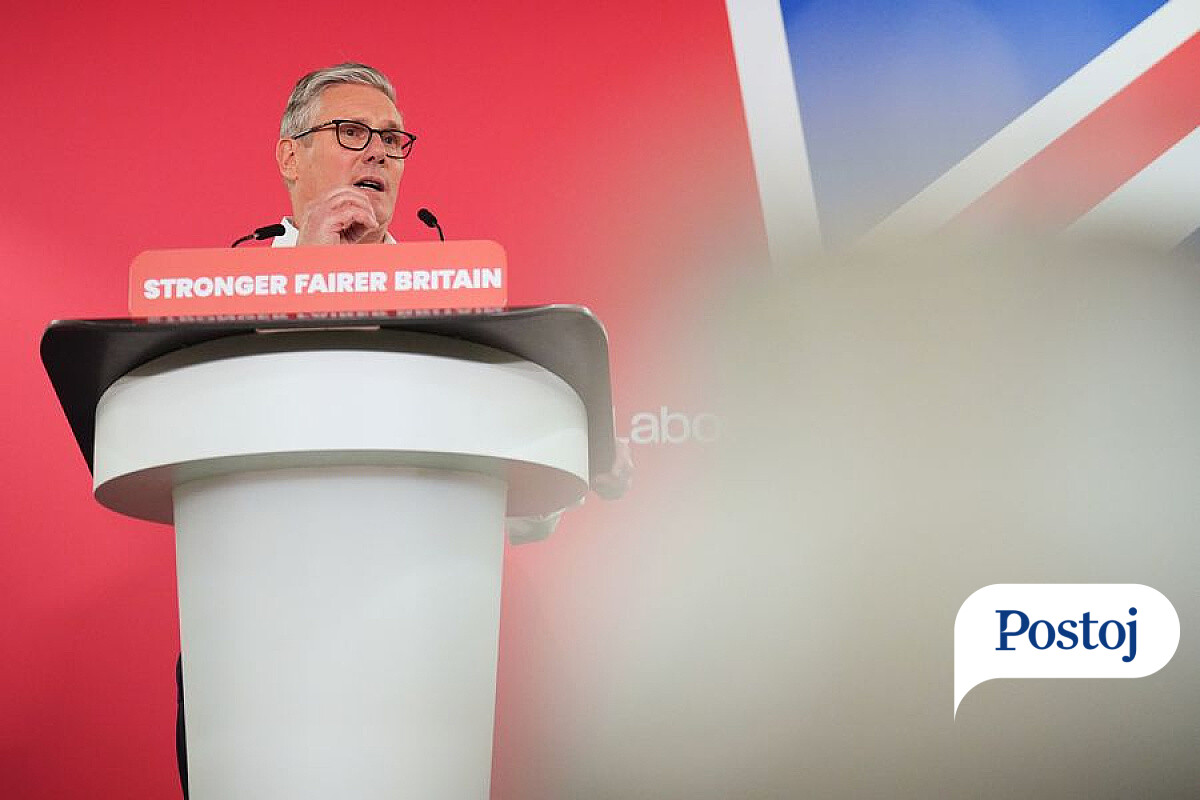
Starmer tried to suppress the discontent of the MPs and made a speech speech with the introduction of another vision. He admitted the many mistakes that had happened, but at the same time promised to continue and complete the reforms and policies that had been started. Perhaps the most interesting part of the speech, however, was his new effort to stand up for rapprochement with the EU, while harshly criticizing previous conservative governments for worsening relations with Europe.
It is not known what Starmer expects from the criticism of Brexit in the current political crisis. It is possible that he just wanted to present a new direction or it is a tactic to win over Green and Liberal Democrat voters. One way or another, this speech did not fulfill its purpose, it did not reassure the party, and the number of MPs calling for his resignation continues to grow.
Several ministers have already indicated that they will oppose him, such as Health Minister Wes Streeting and former Deputy Prime Minister Angela Raynerová. He could also be challenged by Greater Manchester Mayor Andy Burnham, whose bid to fight for a parliamentary seat in January was blocked by the Starmer-controlled top leadership of the Labor Party.
If Starmer were to retain his seat, it would be a minor political miracle.
Source: Postoj

