


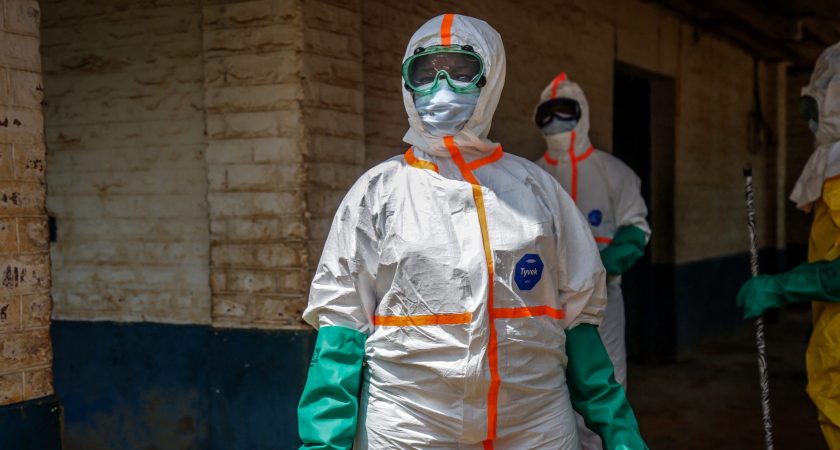
The Ebola epidemic has caused 204 deaths out of 867 suspected cases in the Democratic Republic of the Congo (DRC), according to a recent report by the Ministry of Health published on Saturday, with the health authorities on guard against a risk of propagation in ten African countries.
Ebola has killed more than 15,000 people in Africa over the past 50 years with a mortality rate varying between 25% and 90%, according to the WHO. The most deadly epidemic in the DRC, a vast country in central Africa with more than 100 million inhabitants, had caused nearly 2,300 deaths for 3,500 patients between 2018 and 2020.
The disease causes an extremely contagious hemorrhagic fever and remains formidable, despite the recent vaccines and effective treatments only against the Zaire virus, the origin of most of the epidemics recorded in the past. Uganda, bordering the DRC, confirmed three new cases on Saturday, bringing the total to five, including one death.
In RDC, few laboratory tests have been carried out at this stage, the epicenter of the epidemic is located in a remote area that is difficult to access and is vulnerable to armed groups. The number of officially confirmed deaths has risen to ten and the number of confirmed cases to 91, says the Ministry of Health.
A “fulgurant” epidemic
“We have ten countries at risk” of being affected by the epidemic, alerted Jean Kaseya, boss of Africa CDC, the health agency of the African Union, during a press conference in the Ugandan capital Kampala on Saturday. These are South Sudan, Rwanda, Kenya, Tanzania, Ethiopia, Congo-Brazzaville, Burundi, Angola, Central Africa and Zambia. The epidemic, which could last more than two months, presents however a low risk at the global level, according to the WHO.
In DRC, the virus is already present in three provinces. Part of Ituri (north-east), a gold-bearing region known for intense population movements linked to mining activity, the epidemic spread rapidly in the neighboring regions of North Kivu and South Kivu, where the anti-government armed group M23, supported by Rwanda, controls large areas of the territory. “Mobility and insecurity” facilitate the spread of the epidemic, emphasized M. Kaseya.
Tens of tons of equipment were sent and WHO teams were deployed, but in the heart of the epidemic, the response was slow to organize. Sometimes cut off by roads and torn apart by violence, Ituri is one of the most troubled provinces in the DRC. Its population is estimated at more than 8 million inhabitants, among which more than one million displaced persons are gathered in the camp.
On the other hand, the mistrust of a part of the population is at the origin of the incidents. On the night of Friday to Saturday, a tent provided by Médecins Sans Frontières to a local hospital was set on fire. The installation was empty and no injuries were reported, the NGO said.
Suspended flights
On Thursday, a brief riot broke out in another hospital in the region. The youth claiming the body of a deceased patient entered the ward and burned two isolation tents, according to a hospital official. Mortuary vigils are prohibited in several affected provinces and public gatherings are limited. Traffic on certain roads is also reduced to essential travel.
On Saturday, the Congolese authorities announced the suspension of flights to and from Bunia, the provincial capital of Ituri. Neighboring Rwanda has banned foreign nationals from the Congo since Friday from entering its territory and imposed a quarantine on Rwandans coming from the DRC.
The United States has strengthened health controls at the borders for air travelers from the affected African countries. This Ebola epidemic, the 17th in the DRC, occurs at a time when NGOs are faced with a general decline in international aid, in particular from the United States, which has withdrawn from the WHO.
Source: Lequotidien

